Thematic Classification: Educational Epistemology, Cognitive Neuroscience, Research Methodology, Educational Technology.
Summary
This article examines the structural crisis of contemporary educational systems from the perspective of Complex Phenomenology. It analyzes the phenomenon of "new functional illiteracy" that affects even higher education and graduate studies, characterized by the loss of the ability to abstract, atrophy of critical judgment, and degradation in memory consolidation processes. It contrasts the limits of permissive constructivist positions with the advances of cognitive neuroscience applied to reading learning and the structuring of thought. Additionally, it dismantles the myths of superficial inclusion "at no cost," highlights the ideological bias in educational policy, and evaluates the impact of delegating judgment to generative Artificial Intelligence systems. Finally, it proposes a methodological synthesis based on explicit instruction, mediated scaffolding, and analytical rigor for the training of researchers and doctoral students.
Keywords: Complex Phenomenology, Structured Method, Functional Illiteracy, Reverse Flynn Effect, Cognitive Neuroscience, Artificial Intelligence, Epistemic Criterion.
1. Introduction and Ecosystem Diagnosis
1.1 The Information Paradox and the Reverse Flynn Effect
The global educational ecosystem is going through a historical contradiction: unlimited access to data sources and computational processing tools coincides with a documented regression in the cognitive abilities of the young population. Unlike the trends observed during the 20th century —where Intelligence Quotient (IQ) scores recorded a constant intergenerational increase (Flynn Effect)—, recent psychosocial research demonstrates a Inverse Flynn Effect characterized by a sustained decline in verbal, abstract, and mathematical reasoning skills since the mid-2000s (Bratsberg & Rogeberg, 2018; Dutton et al., 2016).
Figure 1
Ecosistema de Transición Socio-Técnica y Factores de Atrofia Cognitiva en la Era Algorítmica
Note. Flowchart illustrating the divergence between the automation of physical labor (industrial phase) and the outsourcing of higher cognitive functions (algorithmic phase), resulting in the atrophy of reflective judgment and the emergence of functional illiteracy at the university level. Own elaboration.
This phenomenon is not exclusively due to genetic factors, but to ecosystemic determinants and sociocultural habits. Chronic sleep deprivation in children and adolescents —caused by nighttime use of mobile devices and dopaminergic hyperstimulation on social networks— alters the physiological architecture of rest (Walker, 2017). Since the REM sleep phase and slow-wave sleep are biologically essential for the consolidation of long-term memory engrams from working memory, the continued disruption of this cycle inhibits the formation of solid knowledge bases upon which conceptual abstraction is exercised.
1.2 Functional Illiteracy in Higher Education: From Data Loss to Atrophy of Judgment
In response to the deterioration of entry-level competencies, higher education institutions have reacted by relaxing or lowering academic standards to avoid massive failure rates. This dynamic has institutionalized the functional illiteracy in higher education, where graduated professionals have the ability to decode graphic symbols but lack the competence to synthesize a complex text, question its epistemological premises, or build autonomous theory.
As philosopher Fernando Savater (1997) warned, the lack of comprehension does not stem from a lack of access to the text, but from an education foreign to the habit of reasoning. The contemporary illiterate is no longer someone who is unaware of the written code, but someone who, knowing how to read, has lost or not developed the reflective judgment to discern and abstract.
2. Cognitive Neuroscience and Epistemology of the Algorithmic Era
2.1 The Physiology of Learning: Myelination, Sleep, and Memory
From cognitive neuroscience, it is understood that the learning of complex skills (such as reading, mathematics, and formal logic) is not a spontaneous or biologically natural process, but a reconversion or recycling of neuronal areas (Dehaene, 2009). The consolidation of these neural pathways requires deliberate practice, focused repetition, and the strengthening of myelin in the axons to accelerate the transmission of nerve impulses.
When the school environment or individual habits interrupt systematic practice and the consolidation phase of sleep, the subject fails to fix knowledge in long-term memory. Without a structure of stored prior knowledge, the mind lacks cognitive frameworks to operate critical thinking.
2.2 The Algorithmic Substitution: Delegating Task vs. Delegating Criterion
The emergence of generative Artificial Intelligence (AI) tools introduces an acceleration in the delegation of intellectual functions. Throughout history, technology replaced physical burdens to free the intellectual capacity of the subject; currently, automation reaches the functions of synthesis, writing, data analysis, and affective interpretation.
Figure 2
Criteria Matrix of Technological Delegation: Differentiation between Operational Efficiency and Epistemic Renunciation
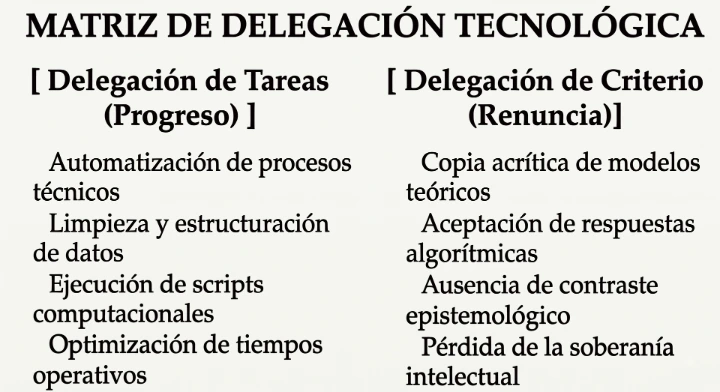
Note. Comparative matrix that contrasts the delegation of instrumental tasks (associated with increased productivity) against the delegation of reflective criteria (associated with the loss of intellectual autonomy and the homogenization of content). Original work.
Research conducted by human-computer interaction laboratories (e.g., Microsoft Research, 2024) reveals an inverse correlation between blind trust in algorithmic models and the user's level of critical scrutiny. Cognitive passivity occurs when the subject confuses the delegation of tasks (vector of efficiency and progress) with the delegation of criteria (ontological and epistemological renunciation).
Similarly, corporate impact studies (McKinsey & Company, 2024) show that, despite more than 80% of organizations having integrated generative AI solutions, only 6% gain a competitive advantage or a differential financial impact. The remaining mass incurs in the hypertrophied production of homogenized and undifferentiated content. This corroborates that the algorithmic tool by itself does not constitute an epistemic advantage; the advantage still resides exclusively in the judgment, abstraction, and character of the researcher directing it.
3. Pedagogical Debate and Evidence-Based Methods
3.1 Dialectic of Teaching Mediation: Between Autonomy (Montessori) and Scaffolding (Vygotsky)
Intellectual training requires overcoming false theoretical dichotomies born from pedagogical dogmatism. The approach of Maria Montessori is often simplistically opposed to the socio-historical framework of Lev Vygotsky. However, a rigorous analysis from the neurobiological bases of learning demonstrates that both models operate complementarily within the cognitive cycle.
Figure 3
Dialectical Model of Pedagogical Mediation: Articulation between the Zone of Proximal Development and Cognitive Autonomy
Note. Decision-making and teacher self-regulation diagram that contrasts technical mediation against cognitive load saturation (Vygotskian scaffolding) versus observational withdrawal in the consolidation of learner autonomy (Montessori myelination). Original work.
The Montessori Approach: Based on autonomous and uninterrupted concentration. Unsolicited teacher intrusion fragments attention, interrupts the myelination process, and generates dependence.
The Vygotskian Approach: Applicable in the Zone of Proximal Development (ZPD) when the level of difficulty exceeds the student's current capacity and threatens to overwhelm the regulation of the prefrontal cortex. At this point, the absence of scaffolding and the inaction of the teacher under the pretext of "autonomy" leads to pedagogical abandonment.
Pedagogical mastery in doctoral and school research consists of acting as a strategic mediator (Vygotsky) when the student faces cognitive collapse, and retreating to non-intrusive observation (Montessori) as soon as processing autonomy emerges.
3.2 The Structured Method versus Lax Constructivism
For decades, the unilateral adoption of permissive versions of constructivism or the "whole language" approach posited that reading and writing are acquired naturally through mere exposure to text-rich environments. The empirical evidence accumulated by reading science (National Reading Panel, 2000; Dehaene, 2009) has categorically disproven this premise.
Programs of Structured Literacy —based on explicit and systematic instruction of grapheme-phoneme correspondence, decoding, syntax, and motor-writing practice— demonstrate significantly superior effectiveness. Experiences of systematic application of this evidence-based method in public jurisdictions (such as the province of Chaco, Argentina, 2024-2025) have recorded increases of over 100% in reading comprehension rates compared to previous cohorts instructed under spontaneous constructivist schemes.
4. Institutional and Sociopolitical Critique of Education
4.1 False Inclusion vs. Mechanical Integration: The Fallacy of Zero-Cost Inclusion
In the realm of public policies, there is a constant confusion between physical integration and substantive inclusion. Forcing the assignment of students with specific educational needs into conventional classrooms without the addition of specialized technical resources is equivalent to mechanically shaking two immiscible substances (like water and oil). The mixture appears homogeneous only while the agitation lasts (the exhaustive effort of the teacher); when the pressure ceases, the most vulnerable students are relegated to the margins of the system.
Figure 4
Operational Divergence between Mechanical Integration and Substantive Inclusion in Educational Environments
Note. Comparative diagram contrasting the implicit segregation generated by spatial integration without adapted resources against the substantive cohesion mediated by specialized human infrastructure (Therapeutic Pedagogy, Hearing and Language) and effective attention time. Own elaboration.
The so-called "zero-cost inclusion" does not constitute a social advance, but rather a modality of institutional abandonment that masks budget cuts through bureaucratic overload on the teaching staff. Genuine inclusion requires the provision of specialized human infrastructure (Therapeutic Pedagogy, Hearing and Language, Social Integration) and the adaptation of evidence-based methodologies.
4.2 Ideologization and Disorientation of Public Policies
Institutional resistance to the adoption of structured methods and explicit instruction often responds to ideological dogmas. Structured teaching and deliberate practice are often mistakenly labeled as "conservative" or "behaviorist" stances, while free discovery approaches are promoted under the banner of "progressive" policies.
This simplification ignores that cognitive neuroscience is not governed by ideological biases. Countries with highly rigorous educational systems across various political spectrums use structured literacy due to its empirical results. Subordinating scientific evidence to political bias condemns vulnerable populations to ignorance and the consequent loss of personal sovereignty and economic independence.
5. Proposal: Complex Phenomenology as an Integration Framework for Doctoral Training
In the face of knowledge fragmentation and the decline of analytical standards, the Complex Phenomenology stands as an epistemological and methodological route for the training of researchers and doctoral students. This framework integrates:
Neurocognitive and Methodological Rigor: Acceptance of empirical and neurobiological data on how the human brain learns, discarding pedagogical dogmas lacking scientific support.
Dialectical and Interdisciplinary Abstraction: Ability to articulate formal logic, the philosophy of judgment, and systems theory in addressing multidimensional educational problems.
Regulated Instrumental Use of AI: Use of computational systems as operational accelerators and data systematization, maintaining the sovereignty of human judgment, hypothesis formulation, and theoretical creation.
Cultivation of Character and Intellectual Discipline: Revaluation of cognitive effort, deep study, and methodical doubt as indispensable virtues for academic practice and civic freedom.
Figure 5
Systemic Structure of Complex Phenomenology as a Framework for Epistemic and Methodological Integration
Note. Synthetic diagram that articulates the three pillars of the phenocomplex approach in educational and research practice: the foundation in neurocognitive evidence, the preservation of reflective judgment and theoretical abstraction, and the regulated instrumental mediation of Artificial Intelligence. Own elaboration.
Conclusions
The reconstruction of educational excellence in the digital age will not come from academic laxity or blind adherence to pedagogical trends. It requires a return to rigor, scientific evidence, and the strengthening of autonomous judgment.
Los profesionales e investigadores de la educación están llamados a trascender la condición de receptores pasivos de tecnologías o políticas ideologizadas, asumiendo una postura de pensamiento crítico fundamentado, capaz de guiar a las nuevas generaciones hacia la verdadera emancipación intelectual.
Bibliographic References
Bratsberg, B., & Rogeberg, O. (2018). Flynn effect and its reversal are environmentally driven. Proceedings of the National Academy of Sciences (PNAS), 115(26), 6673-6678.
Dehaene, S. (2009). Reading in the brain: The new science of how we read. Penguin Random House.
Dutton, E., van der Linden, D., & Lynn, R. (2016). The negative Flynn Effect: A systematic review. Intelligence, 59, 163-169.
McKinsey & Company. (2024). The state of AI in 2024: Generative AI’s breakout year and adoption trends. McKinsey Global Institute.
Microsoft Research. (2024). Human-AI interaction and the cognitive impact of automated reasoning systems. Microsoft Technical Reports.
National Reading Panel. (2000). Teaching children to read: An evidence-based assessment of the scientific research literature on reading and its implications for reading instruction. NIH Publication No. 00-4713.
Savater, F. (1997). The value of educating. Editorial Ariel.
Vygotsky, L. S. (1978). Mind in society: The development of higher psychological processes. Harvard University Press.
Walker, M. (2017). Why we sleep: Unlocking the power of sleep and dreams. Scribner.
Dr. José Javier Leal Rivero
Advisor of the Doctorate in Education and Innovation at the University of Research and Innovation of Mexico - UIIX.